
Genetic tests, unbeknownst too many, are, from my understanding based on this article, eugenically based. Genetic testing was praised by Frederick Osborn, ‘the mastermind of the American Eugenics Society after World War II.’ Frederick Osborn was the man behind the curtain. He came up with ideas to disguise his plan to annihilate the people group of the sick in the womb. He greatly encouraged, “the influence of eugenics–a political ideology–on the science of genetics.” As society stood against the right to life, some came together to contemplate how to change the world for the “utopian” society that they aspired to have, and it caused medicine to falter.
Osborn and the people he worked with had a passion to end the lives of sick children. Osborn and his partners were influencing eugenics into the genetics of science! They were huge proponents of abortion and prenatal testing. Meehan Report shares, ‘”He once told his colleagues in the American Eugenics Society: ‘The public will accept negative eugenics from the doctor in a way it would certainly not accept it from an organized but non-scientific movement.’ Or, as he later said, ‘Eugenic goals are most likely to be attained under a name other than eugenics.’ (19) His establishment connections helped him bring this about. As a trustee of a major foundation, the Carnegie Corporation of New York, Osborn wrote a 1940 memo on its funding of research in human biology. That included what he called a ‘small but fairly rounded program in medical genetics.'(20) Around the same time, he wrote about a conference, funded by eugenics society members, of the ‘Committee on the Registration and Social Control of Subcultural and Defective Groups.” The Rockefeller Foundation, a major funder of eugenics, was represented at the conference.(21) “‘
As we progress in our understanding about prenatal tests, I want us to dive into the underbelly of the eugenic movement and its strong supporters and the vocal hatred that now has been a part of the very life for anyone who is walking through a sickness with your baby.
See here more details, ”
As early as 1941, Osborn had said the public “should insist that doctors and public health authorities get to work at reducing the number of defectives.” This was a recurring theme, and he used economic arguments to back it up. By 1972, when Down syndrome children increasingly were targeted by prenatal testing and abortion, Osborn complained: “Now with modern medical care they can be carried through to an age of thirty to forty years at an expense estimated at over $200,000 for each case of mongolism” (as Down syndrome was then called). But he could claim advance toward a longtime goal. “Reducing the frequency of inherited defects and deficiencies,” he wrote, “has become an important function of medicine and public health. It is not done under the name of eugenics, but it is no less effective for that reason.”(14)
A socialist wing of eugenics has resisted the ideology’s racial and class bias. In the last century, that wing included prominent scientists such as H. J. Muller.(15) The eugenic socialists, though, generally shared the deeper prejudice based on disability. This is one reason why today’s political left accepts the combination of prenatal testing and eugenic abortion. The disability-rights movement did not really get off the ground in the U.S. until the 1970s. Had it started fifty years earlier, it could have done fierce battle with eugenics, and it might have kept the political left true to the principle of equal rights. Eugenics might not have become the powerful monster it is today.
Margaret Sanger–a Planned Parenthood founder and onetime Socialist Party member–was so enthusiastic about eugenics that she belonged to both the American Eugenics Society and its English counterpart. Her prejudice against people with disabilities was deep and unrelenting. In 1922 she complained that “the vicious circle of mental and physical defect, delinquency and beggary is encouraged, by the unseeing and unthinking sentimentality of our age, to populate asylum, hospital and prison.” She spoke of people “who never should have been born at all.” Malformed children, she said, were “biological and racial mistakes.”(16)

Sanger did not improve with age. In 1952 she said people with hereditary disease should not be allowed to marry unless they agreed to be sterilized. Further: “No more children when parents, though showing no affliction themselves, have given birth to offspring with mental and nervous disease–morons, cleft palate, Mongolian idiots.” By “Mongolian idiots,” she meant people with Down syndrome. British Dr. John Langdon Down, who described the condition in the 1800s, mistakenly thought the almond-shaped eyes of such people indicated a link with Mongolians. Idiocy was a term for severe mental retardation, although in fact most people with Down syndrome are not severely retarded.(17) Other demeaning terms for disability have included “harelip” for cleft lip; “lobster claw syndrome” for cleft hand or foot; and “anencephalic monster” for a newborn who is missing part of the brain. Those terms have done much to isolate and dehumanize their targets.
At least Sanger did not call for aborting children with disabilities. But the technology to find handicaps before birth was not available then, and Sanger publicly opposed abortion in any case. In the same talk in which she spoke of “Mongolian idiots,” she dealt with population control and declared: “Abortions break down the health of the mother without preventing renewed pregnancy at an early date. Abortions are the very worst way to prevent increase in the population. Let us make an end to all this suffering, waste, enfeeblement and despair.”(18)
But Planned Parenthood would abandon this approach in the 1960s under the leadership of another eugenicist, Dr. Alan Guttmacher. Meanwhile, Sanger and others had encouraged terrible attitudes toward people with disabilities. And I wonder: Did any of them, as they developed their own disabilities in old age, regret things they had said when they were hale and hearty?
The Great Manipulator
Frederick Osborn realized that overtly racist and political advocates of eugenics had done it much harm in the early 1900s. He once told his colleagues in the American Eugenics Society: “The public will accept negative eugenics from the doctor in a way it would certainly not accept it from an organized but non-scientific movement.” Or, as he later said, “Eugenic goals are most likely to be attained under a name other than eugenics.”(19) His establishment connections helped him bring this about.
As a trustee of a major foundation, the Carnegie Corporation of New York, Osborn wrote a 1940 memo on its funding of research in human biology. That included what he called a “small but fairly rounded program in medical genetics.”(20) Around the same time, he wrote about a conference, funded by eugenics society members, of the “Committee on the Registration and Social Control of Subcultural and Defective Groups.” The Rockefeller Foundation, a major funder of eugenics, was represented at the conference.(21)
Osborn had not served a day in the U.S. military; but as war approached in late 1941, his friend President Roosevelt appointed him a temporary army general and put him in charge of troop morale. Osborn served throughout the Second World War, and his surveys of soldiers’ attitudes gave him helpful background for his eugenics work. He was a great believer in using opinion surveys to shape both strategy and public-relations messages.
After the war, and some diplomatic work for President Harry S. Truman, Osborn plunged back into eugenics. He must have been happy to see the formal launching of the American Society of Human Genetics (ASHG) in 1948. All of the founding officers were eugenicists. The first president, H. J. Muller, was an old-timer in eugenics, going back at least to 1921.(22) He had written a 1939 statement, signed by other leading scientists, that is sometimes labeled the “Geneticists’ Manifesto.” Essentially a declaration of left-wing eugenics, it called for “ever more efficacious means of birth control,” including abortion “as a third line of defense” after sterilization and contraception.(23)
Osborn signed up as a member of ASHG, and in 1958 he served as its vice president. The genetics group was top-heavy with eugenicists in its early years. Ten of its first twelve presidents were linked to eugenics. So were many other early officers and several of its journal editors.
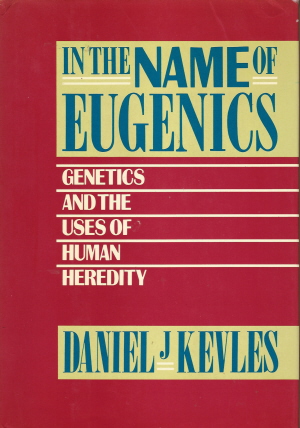
This 1985 book has valuable information on
H. J. Muller and other leading 20th-century
geneticists; but it does not connect the dots
between eugenics and the American Society
of Human Genetics.
In ASHG’s 61 years of existence, over one-third of its presidents have had formal eugenics links. More may have had them, but research on recent decades is difficult. The American Eugenics Society last published a membership list in 1956; so tracking recent members requires much sleuthing in archives and elsewhere. After the society changed its name in the early 1970s, many people assumed it no longer exists. But it is still with us, and still publishes the journal Social Biology.(24)
From 1950 to 1961, the American Eugenics Society paid a great deal of attention to medical genetics. Its publications, first Eugenical News and later Eugenics Quarterly, published information on genetic disease. The society sponsored several conferences related to the topic, including one to encourage genetic advice in marriage counseling and another to promote genetics teaching for medical students. It also persuaded the Population Council to finance several fellowships for postgraduate work in genetics.(25)
It might be more accurate, though, to say that Frederick Osborn decided to finance the fellowships. He was cofounder, first administrator, and later president of the Population Council, which was funded largely by his friend, John D. Rockefeller 3rd. The Council focused mainly on population control in poor countries and among poor people in the U.S. Like other Osborn enterprises, it was stacked with eugenicists. To obtain Council money for genetics fellowships, Osborn took off his eugenics hat, put on his Council hat, and told his Council colleagues what he wanted.(26) As old-time magicians used to say of their own hat tricks, “Presto!”
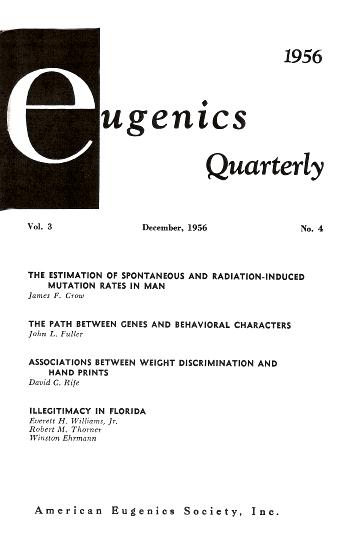
This issue of the American Eugenics Society’s flagship
journal contains the group’s 1956 membership list.
Leading geneticists of the era were on the list.
Osborn also promoted “heredity counseling,” in which geneticists advised couples who feared that a family disease might be passed on to their children. Sometimes a first child already showed evidence of the disease, and the parents worried about the outlook for future children they hoped to have. Geneticists reviewed information on family background and advised on odds of transmission. If the genetic disease was especially devastating and the chance of transmitting it seemed high, a couple might opt for sterilization, contraception, or periodic abstinence–and then adopt children. When Osborn and other officers of the American Eugenics Society issued their report for 1953-57, they called heredity counseling “the opening wedge in the public acceptance of eugenic principles.” They realized, though, that it was an uncertain process–a matter of educated guesses and calculations.
About 20 years earlier, their Eugenical News had reported on eugenic abortion in Nazi Germany and in Denmark.(27) That practice, too, had been based on guesses and calculations. Recently, though, there had been breakthroughs in using amniocentesis for prenatal testing. Amniocentesis dates back at least to the late 1800s, when doctors started to drain amniotic fluid from the womb if a great excess of fluid endangered an unborn child and/or the mother. In the 1950s doctors started using amniocentesis to analyze and manage Rh disease. So the early uses of the technique were truly therapeutic. But in 1955-56, researchers in several countries found that fetal sex could be determined by checking fetal cells in amniotic fluid. This led to abortion of male babies in cases of sex-linked genetic disease. (In hemophilia, for example, when a woman is a carrier, each of her sons has a 50-percent chance of having the disease. Some parents were prepared to abort every son rather than face hemophilia.) Then researchers found that specific diseases could be diagnosed by studying fetal cells retrieved in amniocentesis. Later there would be newer methods of prenatal diagnosis, such as chorionic villus sampling (CVS) and ultrasound.(28)
Pushing the Deadly Combination
Frederick Osborn and his colleagues watched these developments closely. A 1956 report in their Eugenics Quarterly noted that some sex-linked diseases could be detected “at a state of pregnancy where interruption is still possible.” Yet “interruption”–a Danish euphemism for abortion–then was illegal in the United States in nearly all cases. But not for long. The Rockefeller Foundation was funding a project, run by the American Law Institute, to write a model penal code for the states. British eugenicist and legal scholar Glanville Williams was a consultant to the project. In a book published while it was underway, Williams doubted there should be any punishment for “a mother who, finding that she has given birth to a viable monster or an idiot child, kills it.” He supported abortion for fetal handicap. “To allow the breeding of defectives is a horrible evil,” Williams wrote, adding that it was “far worse than any that may be found in abortion.”(29)

Americans Frederick Osborn and Margaret Sanger were
on this English eugenics list, and British scholar Glanville
Williams was a fellow of England’s Eugenics Society by
1959. A few years later, Williams became president of
England’s Abortion Law Reform Association. He was one
of several eugenicists cited by Justice Harry Blackmun
of the U.S. Supreme Court in Roe v. Wade (1973).
Another consultant to the American Law Institute project was Dr. Manfred Guttmacher, a psychiatrist. He happened to be the identical twin of Dr. Alan Guttmacher, an obstetrician, and Alan happened to be vice president of the American Eugenics Society. (Later he would be president of the Planned Parenthood Federation of America and would push that group into strong support of abortion.) Alan Guttmacher sat in on at least two meetings related to the model penal code and, in 1956, reported to his eugenics colleagues: “Even the most liberal American statute [on abortion] makes no reference to any eugenic consideration. The study group took cognizance of this omission and is planning to frame a model statute to include eugenic considerations…” They did just that. When the American Law Institute debated the issue in 1959, a key leader remarked that doctors throughout the country were doing abortions when there was substantial likelihood of defect, “confident that the law cannot mean what it says.”(30)
When the Institute approved the model penal code in 1962, it proposed allowing abortion in several cases, including when a doctor finds substantial risk “that the child would be born with grave physical or mental defect.” Eleven years later, in his 1973 majority opinion in Roe v. Wade, Justice Harry Blackmun said 14 states had adopted “some form” of the Institute’s proposal, but didn’t say how many had adopted the eugenics provision. Blackmun also cited the Glanville Williams book, though not its eugenics statements. But as attorney Rebecca Messall suggested in this Review several years ago, it seems fair to suppose that Blackmun read the book before citing it. She also documented other eugenics influences on Roe.(31) That decision opened the floodgates for prenatal testing and eugenic abortion.
The journal and annual meetings of the American Society of Human Genetics had included information on prenatal testing for several years before Roe, but frank discussion of eugenic abortion had been rare. Dr. Jérôme Lejeune, the French geneticist who had discovered the chromosomal basis of Down syndrome, raised the issue when he received the society’s top award in 1969. In a lecture that leading American geneticists still remembered decades later, Lejeune proposed a special eugenics group–the National Institute of Death–to get rid of embryos and newborns who didn’t meet certain standards. There was a catch, though: “To prevent any possible error, concern, or prejudice, the advisors shall be chosen from among knowledgeable persons not belonging to any philosophy, society, or race.”
Turning from that ironic approach, Lejeune warned his American colleagues: “For millennia, medicine has striven to fight for life and health and against disease and death. Any reversal of the order of these terms of reference would entirely change medicine itself.” He added: “It happens that nature does condemn. Our duty has always been not to inflict the sentence but to try to commute the pain. In any foreseeable genetical trial I do not know enough to judge, but I feel enough to advocate.”(32)
Yet just a year later, American geneticist Arno Motulsky, receiving the same award that Lejeune had, said that prenatal diagnosis “is giving an exciting new dimension to genetic counseling.” He looked forward to development of prenatal testing for sickle cell anemia, believing that this, “followed by selective abortion, would seem easier in the long run” than avoiding mating of carriers or “complicated therapies of the disease.” After the American Eugenics Society changed its name, Dr. Motulsky’s name appeared on its (unpublished) 1974 membership list, and he served on the group’s board of directors in 1988-93.(33)
Marching into Eugenics
The March of Dimes played a huge role in developing and promoting prenatal testing and counseling. Headed for years by Basil O’Connor, friend and former law partner of President Franklin Roosevelt, the foundation had focused on preventing the polio that had paralyzed Roosevelt and many others. The success of polio vaccine in the early 1950s had left the wealthy foundation casting about for another cause. In 1958 it announced a major focus on birth defects. Soon Dr. Virginia Apgar became its Chief of Congenital Malformations. She was a member of the American Society of Human Genetics, and at some point she joined the American Eugenics Society.(34)
Under Apgar and her successors, the March of Dimes vastly expanded the number of genetics counseling centers in the U.S. It put large sums into research to develop prenatal testing. It pressed for insurance reimbursement for that testing and campaigned for government promotion of it. It funded development of the National Society of Genetic Counselors. Audrey Heimler, the first president of this society, appeared on the 1974 membership list of the Society for the Study of Social Biology–that is, the old American Eugenics Society doing business under its new name.(35)
The March of Dimes did, and does, support some positive approaches to improve the health of babies both before and after birth. Yet it also has conducted a relentless drive for prenatal testing. The foundation’s long-published professional journal, Birth Defects, carried many articles that supported eugenic abortion. Writing there in 1971 about prenatal diagnosis for couples who already had one child with disability, three professors bluntly said: “The aim of such a program is the identification of subsequent affected children and their selective abortion.”(36) One writer spoke about “abortion as a means of disease control.” Others even suggested aborting carriers of genetic disease.(37)
As awareness grew about the guilt and grief that eugenic abortion caused to parents, Birth Defects started running articles about grief counseling, support groups for couples, and even funeral services for aborted children. One article noted that prostaglandin abortion “allows for the parents to view and hold their fetus” and also allows “confirmation of structural anomalies by autopsy.” The writers added: “This confirmation may alleviate parental guilt and allow for a more expedient resolution of the grief reaction.” But they coldly suggested that “controlled, psychologic studies” to compare prostaglandin abortion with dilation and extraction (that is, abortion by dismemberment) “are needed before the long-term psychologic effects can be evaluated.”(38)
Other writers offered a protocol for counseling parents through abortion. Among their suggestions: “Validate their decision: What would have been the burden on them? What would have been the effect on their normal children? What would the affected child’s life have been like? Encourage or support the feeling that they had no choice but to terminate.” But what should they tell their other children about the abortion? The writers suggested honesty and reassuring the others that “this can’t happen to them.” They also advised: “Do not implicate the hospital as a place where children go and never return.”(39)
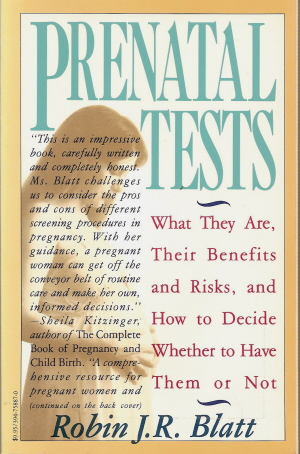
Like the article in the March of Dimes Birth
Defects journal just noted, this 1988
book advised telling siblings of a child who
is aborted for handicap that they will not
be disposed of because of sickness or disability.
Other Birth Defects contributors used the Orwellian words of “selective termination” (killing one unborn twin who is handicapped while sparing one who is not) and “fetal reduction” (killing one or more children when fertility treatments produce twins, triplets, or higher multiples). Doctors do these abortions by injecting potassium chloride to the fetal heart. At Jefferson Medical College in Philadelphia, the writers reported, “As many as four fetuses were terminated at one session.” In the case of second-trimester abortion for handicap, nothing was left to chance: “All pregnancies were rescanned 30 minutes following the initial injection…and if cardiac activity was identified, a repeat procedure was performed the same day.” The writers acknowledged, “Many couples question the level of ‘consciousness’ that the remaining fetuses have and wonder if the remaining fetuses somehow know that one of their potential sibs was terminated. These couples wonder if children who remain will, as they grow, be a constant reminder of the fetuses that were terminated.”(40)
Perhaps March of Dimes leaders finally realized that Birth Defectswas a house of horrors. The last issue was published in 1996.
When under attack from right-to-lifers, the March of Dimes claimed that it provided testing and counseling only, that it did not do abortions or advocate for them. Asked about this claim in 1992, Dr. Jérôme Lejeune said it would be the same as saying, “I’m selling guns to terrorists. I know they are terrorists, but I am just selling guns. Nothing more than that.”(41) Lejeune, who died two years later, was one of the greatest defenders of the bedrock medical rule, “First, do no harm.” And one of very few in genetics.”
Resources: http://www.meehanreports.com/
http://darkwing.uoregon.edu/~adoption/topics/eugenics.htm
 His Love & Care